How to Pick a Book Club Book Nobody Secretly Hates
Quick Answer: Rotate picking responsibility and require the picker to explain in one sentence why they chose it — a short reason filters out picks chosen just because they’re trendy or safe, and gives the group real information before committing.
Most book club dissatisfaction isn’t about the book being bad, it’s about nobody feeling like they had real input, which quietly builds resentment even when the group keeps showing up.

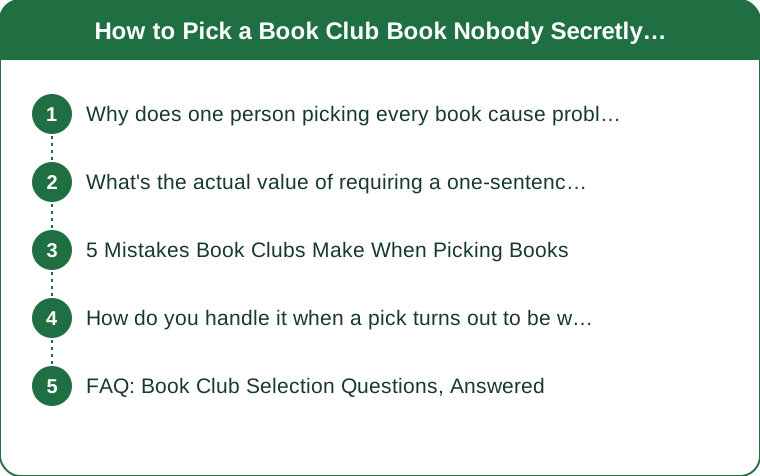
Why does one person picking every book cause problems, even if their taste is good?
Even a consistently good picker eventually narrows the group toward one taste profile, which slowly alienates members whose interests differ, even if they never say so directly. Rotating the pick, even among 3-4 regular members, keeps the range wide enough that most people feel represented over a full year.
What’s the actual value of requiring a one-sentence reason for each pick?
It surfaces picks made for weak reasons (“it was on a bestseller list”) versus genuine ones (“I think this connects to what we discussed last month”), and groups tend to engage more with picks that have real intention behind them. It also gives other members a chance to flag early if the reason doesn’t resonate, before the whole group commits a month to it.

5 Mistakes Book Clubs Make When Picking Books
1. Picking only bestsellers, assuming popularity means discussability — some bestsellers are actually thin on discussion material despite being widely read.
2. Never picking anything outside the group’s comfort genre, which slowly narrows engagement over time.
3. Letting the same one or two people pick every single month.
4. Picking books that are too long for the group’s actual reading pace, leading to unfinished reads and thinner discussions.
5. Not checking discussion-guide availability — books with genuinely rich, ambiguous themes discuss better than plot-driven page-turners, even if the page-turner was more fun to read.
How do you handle it when a pick turns out to be widely disliked?
A quick, low-pressure check-in (“who actually finished it, and would people pick something like this again?”) after a lukewarm discussion night is more useful than assuming silence means it went fine — most groups avoid this conversation and repeat the same mismatch months later.
FAQ: Book Club Selection Questions, Answered
Should book club picks always be voted on by the group?
A vote among 2-3 shortlisted options (chosen by the rotating picker) balances individual ownership with group input better than either a single dictator pick or a fully open vote.
How do you handle a member who consistently dislikes every pick?
A direct, kind conversation about what they’d actually enjoy reading is more productive than continuing to guess.
Is it okay for a book club to skip discussing a book that flopped?
Yes — briefly acknowledging it didn’t land and moving on is completely reasonable and often better than forcing a thin discussion.
TL;DR:
- Rotate the picking responsibility to avoid narrowing toward one person’s taste
- Require a one-sentence reason for each pick to filter out weak selections
- Books with rich, ambiguous themes tend to discuss better than fast plot-driven reads
- Check in honestly after a lukewarm pick instead of assuming silence means it worked
Keep Reading
This article is for general informational and styling purposes only. Fit, sizing, and product availability may vary.