5 Icebreakers That Actually Work for Welcoming New Book Club Members
Quick Answer: New book club members often stay quiet for their first couple of meetings simply because there’s no structured moment for them to be introduced beyond a quick name-drop. Five simple icebreakers — used once at the start of the meeting — reliably get new members talking within their first session.
Your new member showed up right on time, said hello, and then spent the entire discussion nodding along without saying much else. That’s not a personality problem. It’s usually a missing five minutes at the start of the meeting.

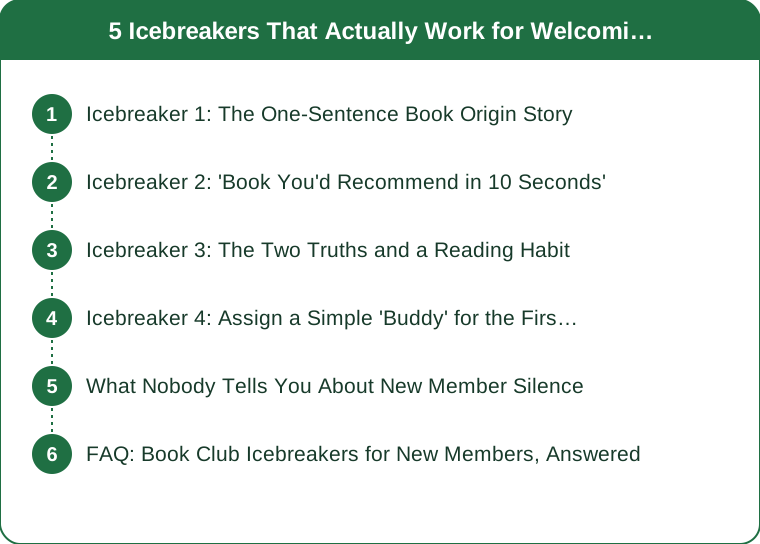
Icebreaker 1: The One-Sentence Book Origin Story
Go around the group and have everyone, new and existing members alike, share one sentence on how they first found this book club or what drew them to reading in general. This puts new members on equal footing since even longtime members are sharing something, not just being interviewed.
It takes under five minutes total and gives the new member a natural, low-pressure entry point before the actual book discussion begins. Going in a predictable order, rather than randomly calling on people, also reduces anxiety for anyone who dislikes being put on the spot unexpectedly.
Icebreaker 2: ‘Book You’d Recommend in 10 Seconds’
Ask each person, including the new member, to name one book they’d recommend to the group in a single sentence, no explanation required beyond the title and why in a few words. This works well because it’s about their taste, not a performance of insight about tonight’s book.
It also gives the host useful information for future book picks, so it doubles as both an icebreaker and light research. Genre variety tends to surface naturally this way too, which can spark ideas for future meetings without a separate planning conversation.
Icebreaker 3: The Two Truths and a Reading Habit
A lighter, more playful version of the classic icebreaker: each person shares two true things and one false thing about their reading habits (never finishes a series, always reads the last page first, etc.), and the group guesses which is false. New members tend to loosen up fast with this one because it’s genuinely fun, not just informational.
Keep it to under 10 minutes total for a group of 6-8 people so it doesn’t eat into discussion time.

Icebreaker 4: Assign a Simple ‘Buddy’ for the First Meeting
Pair the new member with one existing member beforehand who sits next to them and makes a point of including them in the conversation naturally. This isn’t a formal announcement, just a quiet arrangement that ensures the new member isn’t left to find their own way into the discussion cold.
Most hosts find this single step does more for retention than any amount of general friendliness from the group as a whole. It also gives the new member one friendly face they can text a quick question to before the next meeting, rather than feeling like they have to figure out group norms entirely alone.
What Nobody Tells You About New Member Silence
Most groups assume a quiet new member just needs time to warm up, but often the real issue is that they don’t yet know the group’s unwritten discussion norms — how deep to go, whether tangents are welcome, how critical it’s okay to be about the book. A quick, casual heads-up before the meeting (‘we go pretty deep, feel free to jump in anytime’) removes more anxiety than people expect.
This single sentence, sent in a text before the meeting, is one of the most underused tools for helping new members feel like they can actually participate.
FAQ: Book Club Icebreakers for New Members, Answered
How long should icebreakers realistically take?
Keep the whole icebreaker segment to 5-10 minutes for a group of 6-8 people — long enough to be genuine, short enough that it doesn’t eat into the book discussion itself.
Should icebreakers happen every meeting or just when there’s a new member?
Most groups only need them when welcoming someone new; using them every meeting can start to feel repetitive for the regular members.
What if the new member still seems quiet after the icebreaker?
That’s normal for some people — following up with a direct, easy question later in the discussion (‘what did you think of the ending?’) often works better than a general opening.
Should the host be the one running the icebreaker every time?
Not necessarily — rotating who leads the icebreaker, alongside rotating who hosts, keeps the responsibility spread out and prevents it from feeling like one person’s job forever.
TL;DR:
- New members often stay quiet simply because there’s no structured moment to bring them in
- A quick one-sentence origin-story or recommendation round levels the playing field fast
- Pairing a new member with a ‘buddy’ for their first meeting boosts natural inclusion
- A pre-meeting heads-up about the group’s discussion style removes hidden anxiety
Try one icebreaker at your next meeting with a new member and notice how much faster they join the conversation.
Keep Reading
This article is for general informational and styling purposes only. Fit, sizing, and product availability may vary.