Audiobook Members, Print Members, and the Discussion Problems Nobody Plans For
Quick Answer: Mixed print and audio groups run into three predictable problems: nobody can find the same passage, listeners and readers remember different details, and pacing expectations diverge because listening time and reading time are not comparable. Fix all three by referencing chapters rather than page numbers, asking questions about arc and character rather than specific wording, and setting the deadline by chapter rather than by percentage. None of it requires anyone to change how they consume the book.
Half your group finished it on a commute, half read it in bed, and the discussion keeps stalling on somebody saying: sorry, which bit is that?

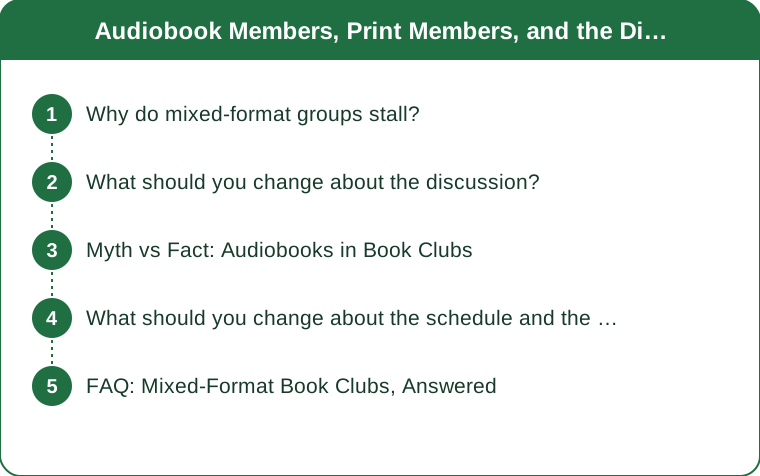
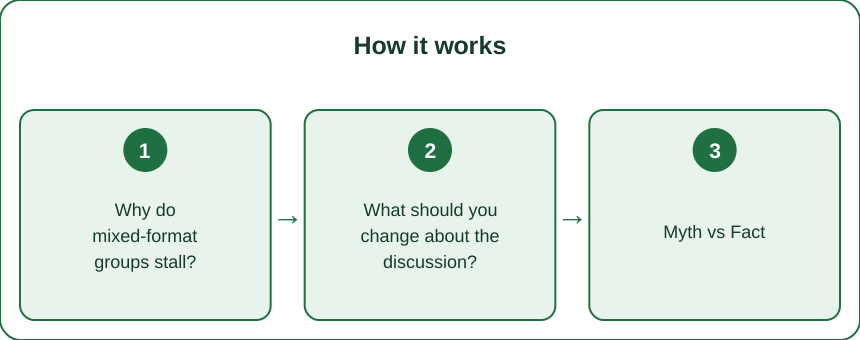
Why do mixed-format groups stall?
Passage-finding breaks down completely. Print readers cite a page, ebook readers have a percentage that depends on their font size, and listeners have a timestamp that depends on the narrator’s pace and playback speed. Nobody can follow anybody.
Recall works differently by format. Listeners frequently have a stronger sense of voice, tone, and character - narration does a lot of interpretive work - while readers more often recall exact phrasing, structure, and anything visual on the page. Neither is better, but a discussion built on quotations disadvantages one group.
Pacing expectations diverge quietly. An audiobook can be a solid twelve hours, and a listener at 1.5 speed finishes in eight while a reader might spend six. Somebody always feels behind, and it is rarely the person who chose the format.
Audio makes some books much harder. Multiple narrators, non-linear timelines, unfamiliar names, maps, family trees, and footnotes are all significantly more demanding by ear. A book with a cast list at the front is a warning sign for a mixed group.
And there is often unspoken judgement. The did-you-really-read-it question hovers, and it makes listeners defensive and quieter in discussion - which is the actual loss, because they usually have the most to say about character and voice.
What should you change about the discussion?
Reference by chapter, always. Chapters exist in every format and are the only universal coordinate. Establish it as the group norm: the scene at the end of chapter eleven, not page 217.
Ask about arc rather than about wording. When did you stop trusting the narrator, what did the ending do to your reading of chapter one, and whose version of events do you actually believe are all questions everyone can answer regardless of format.
Keep at most one quotation question and flag it in advance. If somebody wants to discuss specific prose, say so when the book is set so listeners can note the chapter or switch for that section.
Ask listeners about the narration directly. It is genuinely part of their experience and it is interesting to readers - a narrator’s choices can substantially change how a character reads, and that is excellent discussion material rather than a footnote.
And let people say they skimmed or sped up. Groups that permit honesty about how the book was consumed have better discussions than groups where everyone performs completeness.

Myth vs Fact: Audiobooks in Book Clubs
Myth: Listening is not really reading. Fact: research comparing the two generally finds comprehension is broadly similar for straightforward narrative material, with differences appearing for dense, technical, or non-linear texts. For most book club fiction, the gap is small.
Myth: Listeners retain less. Fact: retention depends heavily on attention rather than format. Listening while doing something demanding reduces retention; listening while walking or doing chores that require little thought generally does not. The equivalent for readers is reading three pages before falling asleep.
Myth: Audiobook listeners have not done the work. Fact: a twelve-hour audiobook is twelve hours of attention, which is frequently more time than a fast reader spent. Time invested is not the useful measure anyway - engagement is.
Myth: You cannot discuss quotations if half the group listened. Fact: you can, if you flag it in advance. Listeners can bookmark and note chapters, and most apps make clipping straightforward.
Myth: Mixed groups have to pick one format. Fact: mixed groups tend to have richer discussions once the coordinate problem is solved, precisely because the two formats surface different things about the same book.
What should you change about the schedule and the picks?
Set the deadline by chapter, not by percentage. Read to the end of chapter fourteen for next time works for everyone. Read to 60 percent works for nobody except the person who said it.
Check the audiobook length before choosing the book. A 400-page novel might be a comfortable eleven hours or a punishing twenty-two, and the length is public information. Groups that check this avoid most pacing complaints.
Avoid structurally difficult books for mixed groups, or warn people. Multiple timelines, large casts with similar names, epistolary formats, and heavy footnoting are all much harder by ear. If the group loves the book anyway, say so when you set it so listeners can plan.
Split long books across two sessions. This is the single most effective schedule fix for autumn, when everybody’s routines are compressing at once and the assumption that people have long stretches of free reading time stops holding.
Mention library audiobook access when you set the book. Cost is a real barrier, and library apps carry most popular titles - which frequently determines whether somebody participates at all.
And use the September restart properly. The next few weeks are when book clubs traditionally relaunch after a scattered summer, which makes this the natural moment to agree the chapter-reference norm and the deadline format rather than discovering the problem again in October.
FAQ: Mixed-Format Book Clubs, Answered
Does listening to an audiobook count as reading it?
For book club purposes, yes. Comprehension research generally finds the two comparable for straightforward narrative material, and the differences that do appear are mostly in dense or non-linear texts rather than typical book club fiction.
How do you reference passages when people used different formats?
Use chapters. Page numbers vary by edition, ebook percentages vary by font size, and audio timestamps vary by narrator and playback speed. Chapters are the only coordinate that exists identically in every format.
What kinds of books are hardest on audio?
Books with large casts of similarly named characters, multiple timelines, maps or family trees, heavy footnotes, and epistolary structure. Flag these when you set the book so listeners can plan or switch formats for the tricky sections.
How do you set a fair deadline for a mixed group?
By chapter rather than percentage, and with a check of the audiobook length before choosing the book. Splitting long titles across two sessions solves most of the remaining pacing complaints.
TL;DR:
- Mixed-format groups break down on three things: finding passages, differing recall, and pacing - all three are fixable in advance.
- Reference chapters, never page numbers or percentages, since chapters are the only universal coordinate.
- Build questions around arc, character, and trust rather than exact wording, and flag any quotation question when you set the book.
- Ask listeners about the narration - it is real discussion material, not a consolation question.
- Check the audiobook length before choosing, split long books across two sessions, and mention library access.
The autumn relaunch is the natural moment to agree these norms. Do it once and the discussion stops stalling on logistics.
Keep Reading
This article is for general informational and styling purposes only. Fit, sizing, and product availability may vary.