When Your Book Club Can Never Agree on a Genre, Try This Instead
Quick Answer: A rotating theme system — where each month has a loose theme (“a book in translation,” “under 250 pages,” “published this decade”) instead of a fixed genre — lets every member pick within their taste while still giving the group shared structure and variety.
Genre arguments are rarely really about genre — they’re about different members wanting to feel like their taste matters in the group’s choices.

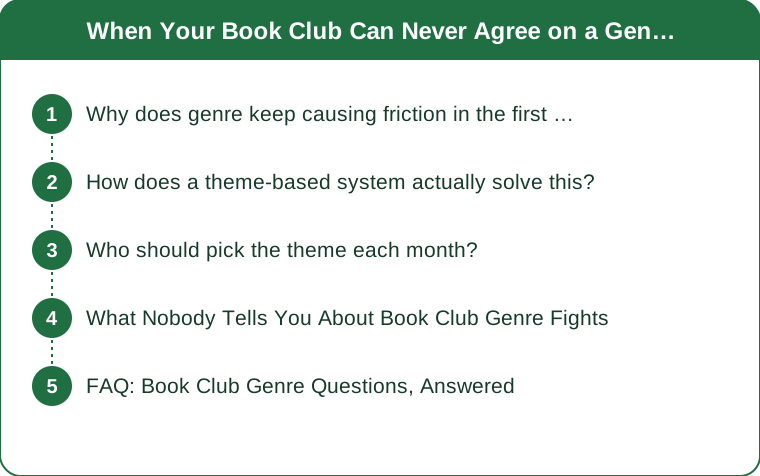
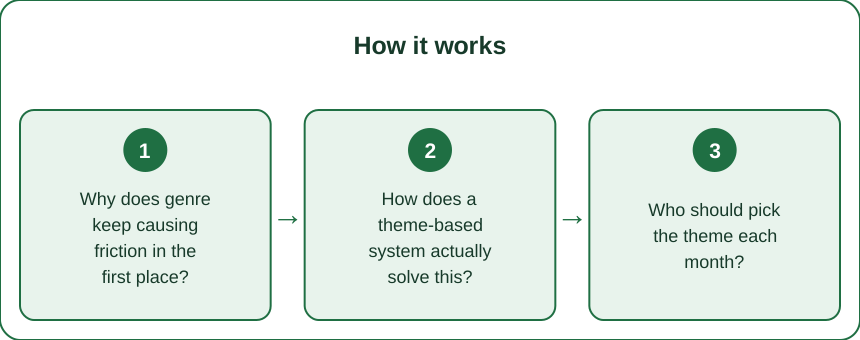
Why does genre keep causing friction in the first place?
When one person’s genre preference dominates repeatedly, other members quietly disengage even if they don’t say so directly — most book club attrition traces back to feeling unheard in book selection more than scheduling conflicts, which get blamed instead because they’re easier to admit.
How does a theme-based system actually solve this?
A loose theme like “a book you’ve been meaning to read for years” or “a debut novel” gives structure without dictating genre — a member can bring a literary debut while another brings a thriller debut, and both fit. This preserves variety while ending the recurring genre standoff.

Who should pick the theme each month?
Rotating the theme-picker role along with the book-picker role (not necessarily the same person) spreads ownership further and prevents the same 1-2 voices from shaping every month’s direction, which is often the real source of quiet resentment in long-running clubs.
What Nobody Tells You About Book Club Genre Fights
The members who push hardest for their preferred genre are often the members most at risk of quietly leaving if overruled repeatedly — the loudest voice in a genre debate is frequently signaling investment, not stubbornness, which is worth remembering before dismissing their pick.
FAQ: Book Club Genre Questions, Answered
What if half the group hates the theme-based system?
Try it for 3 months before deciding — most resistance comes from unfamiliarity with a new structure, not the structure itself.
Should genre-specific members just start a separate club?
Sometimes that’s genuinely the right call if tastes are truly incompatible, but a theme system resolves it for most groups before it gets to that point.
How do you pick a theme that’s specific enough to be useful?
Aim for themes with a clear boundary (page count, publication era, format) rather than vague ones like “something interesting,” which don’t actually narrow anything.
TL;DR:
- Genre fights are usually about feeling heard, not genre itself
- A rotating loose theme (not a fixed genre) preserves variety while giving structure
- Rotate the theme-picker role separately from the book-picker role
- Give a new system 3 months before judging whether it’s working
The goal was never to make everyone read the same kind of book — it was to make everyone feel like their taste still counts.
Keep Reading
This article is for general informational and styling purposes only. Fit, sizing, and product availability may vary.