The Book Club Member Who Won't Stop Talking: How to Fix It Without an Awkward Confrontation
Quick Answer: The most effective fix is structural, not confrontational — introducing a simple discussion format (like a round-robin opening comment before open discussion) naturally redistributes talking time without singling anyone out, and it works far better than a direct one-on-one conversation for most groups.
Every meeting follows the same pattern: one person takes up half the discussion time, everyone else nods along, and by the end two or three people never got a word in. Addressing it directly feels awkward and risky for a friendship. There’s a quieter fix that usually works just as well.

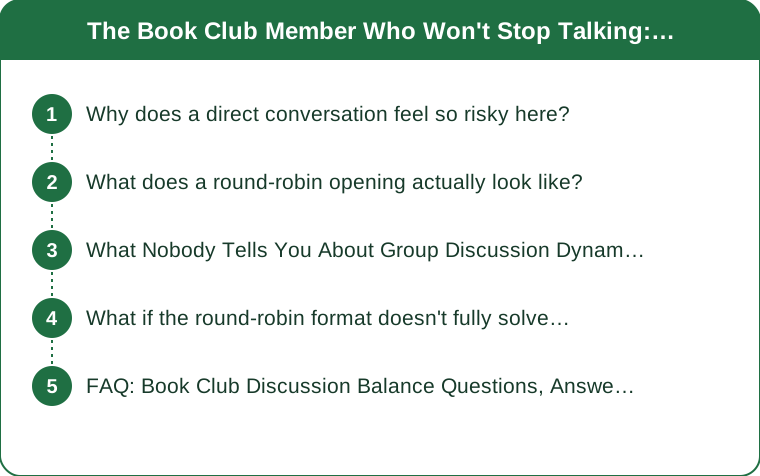
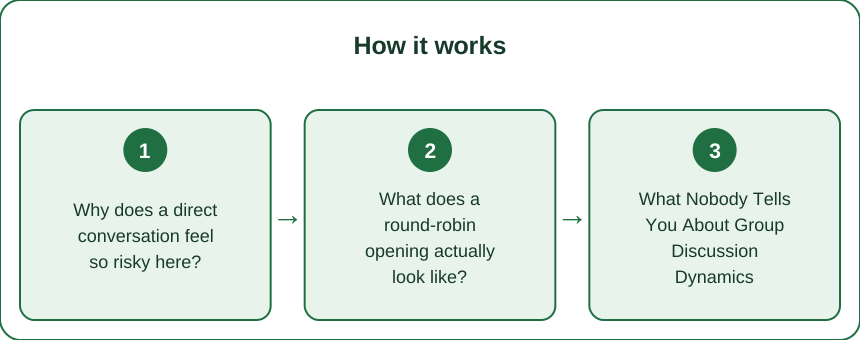
Why does a direct conversation feel so risky here?
Because it frames the issue as a personal criticism (‘you talk too much’) rather than a group dynamic, which can feel disproportionately harsh for what’s usually an unconscious habit, not a deliberate choice to dominate. Many enthusiastic talkers genuinely don’t realize how much space they’re taking up.
A structural fix sidesteps this entirely by changing how the whole group’s discussion works, rather than addressing one person’s behavior specifically.
What does a round-robin opening actually look like?
Start each meeting with one comment per person, in order, before opening up to free discussion — something as simple as ‘one thing that stood out to you.’ This guarantees every voice is heard early, before the conversation naturally drifts toward whoever talks fastest or loudest.
It takes maybe 5-10 extra minutes and dramatically changes the dynamic for the rest of the meeting, since quieter members have already spoken once and feel more comfortable jumping in again later.

What Nobody Tells You About Group Discussion Dynamics
The person dominating discussion is very often just as unaware of the pattern as everyone else is uncomfortable with it — group dynamics research consistently shows that the most vocal member in a group underestimates their own talking time, while quieter members overestimate how much they’ve contributed. Neither perception matches reality.
This is exactly why a structural fix works better than confrontation: it doesn’t require anyone to admit fault, it just changes the default pattern everyone falls into without thinking.
What if the round-robin format doesn’t fully solve it?
A designated discussion facilitator role, rotating meeting to meeting, can help — their job for that session is specifically to redirect (‘let’s hear from someone who hasn’t spoken yet’) without it being one person’s permanent, awkward responsibility.
For persistent cases, a brief private conversation framed around the group (‘I want to make sure everyone gets a chance to share, can you help me watch for that?’) tends to land much better than one framed around their individual behavior.
FAQ: Book Club Discussion Balance Questions, Answered
Is it rude to interrupt someone who’s talked too long?
A polite redirect (‘great point — let’s hear what others thought too’) is generally well received and not considered rude in a group discussion setting, especially if it becomes a normal part of how the group runs.
Should I say something directly to the person after a meeting?
Only if structural fixes haven’t worked after a few tries, and even then, frame it around the group’s goals rather than their individual behavior.
What if I’m the person who tends to talk the most?
Asking a trusted member for honest feedback, and proposing the round-robin structure yourself, is a low-pressure way to address it without it becoming an uncomfortable conversation about you specifically.
TL;DR:
- A structural fix (round-robin opening comments) usually works better than direct confrontation
- The dominant talker is often genuinely unaware of the pattern — this isn’t usually deliberate
- A rotating facilitator role can help redirect discussion without singling anyone out
- If structure doesn’t work, frame any direct conversation around the group’s goals, not the person’s behavior
Change the format before you change the conversation — it solves the problem for most groups without anyone feeling called out.
Keep Reading
This article is for general informational and styling purposes only. Fit, sizing, and product availability may vary.