Book Club Questions That Get Past 'So, Did Everyone Like It?'
Quick Answer: Skip ‘did everyone like it’ and ask questions that require a position: which scene are you still thinking about, which character would you defend, what choice did the author make that you would have made differently, and where did the book brush against your own life. Open with a fast one-word-reaction round so everyone speaks in the first five minutes, let silences sit for a few seconds, and keep one wildcard question in reserve for the lull.
Every struggling book club believes it has a book problem or a people problem. It almost always has a question problem. The same eight people who produced forty minutes of dead air over a prize-winner will argue happily past midnight when someone asks the right kind of question - and the right kind is learnable.

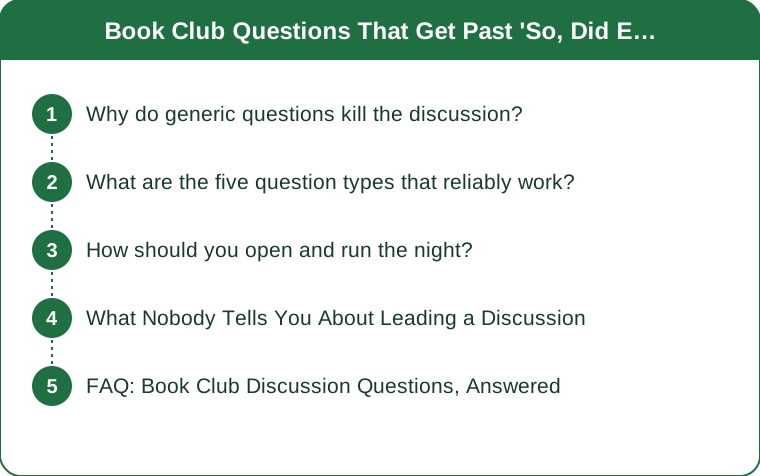
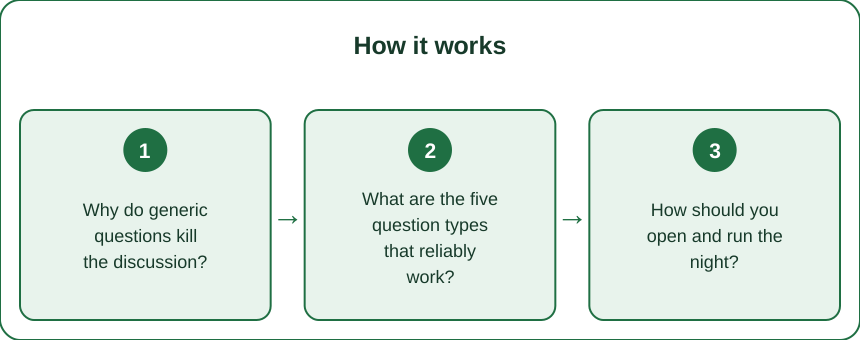
Why do generic questions kill the discussion?
Because they can be answered completely in one sentence, and everyone politely does.
‘Did you like it’ produces a ratings round. ‘What did you think of the ending’ produces a summary round. Both are closed loops: each person delivers a verdict, the verdict requires no response, and the group moves on with nothing to push against. Twenty minutes in, the discussion is over and the wine portion of the evening begins early - which is fine, but nobody needed to do the reading for that.
Good discussion questions have three properties. They require a position someone could disagree with. They point at something specific - a scene, a decision, a line - rather than the whole book at once. And they have no correct answer that ends the conversation.
There is also a structural reason early questions matter most: whoever speaks first sets the register. If the first answer is a safe summary, the group calibrates to safe summaries all night. If the first answer is a slightly risky opinion, the group learns that risky opinions are welcome here. The host’s real job is not to have twenty questions - it is to make the first ten minutes establish that this is a room where you can say the book infuriated you.
What are the five question types that reliably work?
1. The lingering-scene question. Which scene are you still thinking about, days later - and why that one? It starts with specifics, invites feeling rather than judgment, and eight people reliably name different scenes, which instantly generates material.
2. The defense brief. Pick the character everyone disliked and ask someone to defend them - their best argument for why the character acted as they did. Nothing wakes a room like licensed disagreement, and it moves people off verdicts and into interpretation.
3. The author’s-choice question. Why do you think the author chose this - the ending, the split timeline, that narrator, killing that character off-page? You are not asking whether it worked; you are asking what it was for. This is the question that makes a group feel smart, because it usually uncovers something someone noticed and nobody else did.
4. The bridge question. Where did this book touch your own life? Used once per night, deliberately, this is the question that turns a reading group into actual friends. Used more than once, it hijacks the book entirely - one bridge per evening.
5. The one-line stakes question. If you had to say what this book is actually about in one sentence - not the plot, the point - what is your sentence? Save it for last. The comparison of eight different sentences is routinely the best five minutes of the night.

How should you open and run the night?
Open with the lightning round: one word or one sentence of first reaction, no elaboration, around the whole circle. It takes four minutes, it is fun, and it does the invisible structural work - every person has now spoken, which research on group discussion and every host’s experience agree makes them far likelier to speak again. It also hands the host a map: you heard who said ‘furious’ and who said ‘meh’, and you know exactly who to call on when a question needs a spark.
Then sequence loose-to-tight: lingering scene first, defense brief and author’s-choice in the middle, the bridge question once, stakes question to close. Five questions genuinely fill ninety minutes if you let answers breathe.
Letting answers breathe means tolerating silence. Five to eight seconds of quiet after a real question is people thinking, not the evening dying. Hosts who panic and answer their own questions train the group to wait them out. Count to eight in your head; someone almost always breaks first with something better than filler.
Two more mechanics: gently ration the enthusiastic - a warm ‘I want to hear where Dana lands on this’ redirects without wounding - and never run the night as a quiz with your printed questions as the syllabus. The list is a parachute, not an itinerary. The best discussions leave half the questions unasked because the group found its own thread, and the host’s finest move is letting them.
What Nobody Tells You About Leading a Discussion
The people who did not finish are an asset. Every meeting has one or two, radiating guilt. Give them a standing legal question: based on where you stopped, what did you expect to happen - and were you right? Their wrong predictions are frequently the most revealing thing said all night, because they expose what the author set up versus what she delivered.
Disagreement is the product, not the hazard. New hosts smooth over splits in opinion as if harmony were the goal. The split is the goal. When two people read the same marriage, the same ending, the same mother completely differently, park the group there and dig - that gap is where book clubs earn their existence.
The book being disliked is a great night waiting to happen. A unanimous rave produces ninety minutes of agreement; a book half the room hated produces the best meeting of the year. Never apologize for a divisive pick.
Over-preparation reads as control. A host with twelve typed questions and a highlighted copy can accidentally turn peers into students. Three questions you care about beat twelve you printed.
And end five minutes before the energy does. Close on the stakes question while the room is still warm, pick the next book, done. Groups remember how the night ended - a discussion that stops slightly too early gets rejoined next month with momentum.
FAQ: Book Club Discussion Questions, Answered
What is the best first question to ask at book club?
A whole-circle lightning round - one word or sentence of raw reaction - followed by ‘which scene are you still thinking about?’ Together they get every voice in early and land the discussion in specifics.
How do I handle one person dominating the discussion?
Use names to redirect: ‘I want to hear what Priya thought about that scene.’ It is warm, it works instantly, and repeated use trains the rhythm without a confrontation.
What do we do when nobody talks?
Wait a full eight seconds first - most silence is thinking. If it truly holds, drop the current question and go concrete: read one short passage aloud and ask what the author is doing there. Specific beats broad every time a room stalls.
Should members who did not finish the book still come?
Yes, always - attendance beats completion for keeping a club alive. Give them the prediction question, warn the room before major spoilers, and let the meeting itself sell them on finishing.
TL;DR:
- Generic verdict questions produce a ratings round; questions requiring a position produce a discussion.
- The five that work: lingering scene, character defense, author’s choice, one bridge to real life, and the one-sentence stakes closer.
- Open with a whole-circle lightning round, tolerate eight-second silences, and treat your question list as a parachute.
- DNF members, disagreement, and disliked books are assets - and end five minutes before the energy dips.
A book club is a machine for turning solitary reading into shared thinking, and questions are the crank. Bring three you actually care about, get every voice in the room early, and the group will do the rest - usually past the time you meant to finish.
Keep Reading
This article is for general informational and styling purposes only. Fit, sizing, and product availability may vary.