When Half Your Book Club Finishes in Three Days and Half Never Start
Quick Answer: Reading speed differences are a scheduling problem, not a commitment problem. Fix them structurally - set page targets rather than whole books for long titles, cap book length, run a two-tier discussion for those who finished and those who did not, and stop treating not-finishing as a failure. Groups that adapt to the range survive; groups that expect everyone to match the fastest reader do not.
Every book club has a Sarah who finished it on the train home and a Priya who is on page forty and slightly embarrassed. The usual response is to pretend the range does not exist, which is exactly what makes people stop coming.

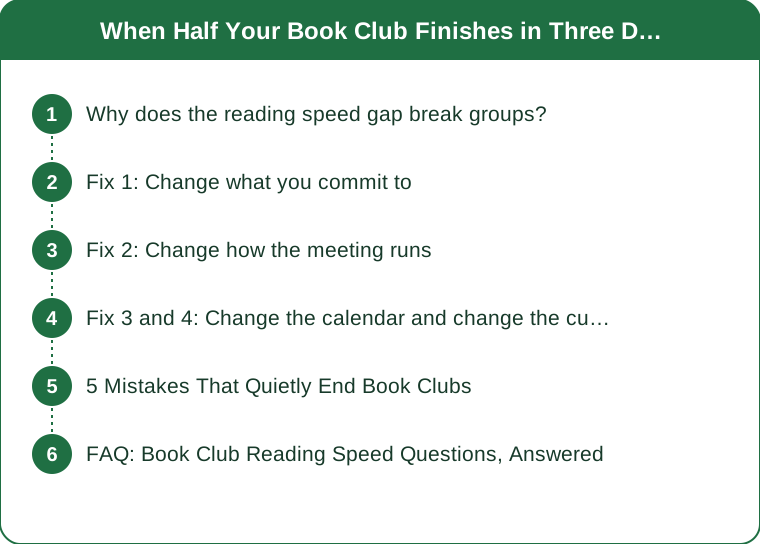
Why does the reading speed gap break groups?
Because it produces two silent, opposite frustrations that nobody voices.
The fast readers get bored. They finished three weeks ago, the details have faded, and they spend the meeting carefully avoiding spoilers instead of discussing anything. Some start reading two books ahead. Some quietly disengage.
The slow readers feel judged. Arriving at page sixty of four hundred is uncomfortable in a room where others are discussing the ending. The most common response to that discomfort is not reading faster - it is not turning up. And a member who misses two meetings in a row usually leaves.
The range is genuinely wide and mostly not about effort. Average adult reading speeds vary considerably, and total reading time varies far more than speed does. Someone with a commute and a quiet flat has ten hours a week. Someone with young children and shift work has forty minutes. A group set at the pace of the person with the most free time excludes everyone else by default.
Other factors that widen it further:
- Reading format - audiobook listeners can absorb during commutes and chores, which shifts capacity dramatically
- The specific book - dense literary fiction and translated prose read at a fraction of the speed of a thriller
- Life phase - new parents, carers, and anyone in a demanding work period drop temporarily
- Neurodivergence and dyslexia, which affect reading rate substantially and are rarely mentioned aloud
The mistake most groups make is treating this as a motivation issue and applying social pressure. Pressure does not create reading time. It creates absent members.
Fix 1: Change what you commit to
The most effective structural change, and the one groups resist most because it feels like lowering standards.
Cap the page count. Agree a ceiling - 350 pages is a common and workable limit for a monthly group - and treat anything longer as a special project with a longer timeline.
- Removes the single biggest cause of non-completion
- Makes the commitment predictable, which helps people plan
- The best discussions rarely correlate with length anyway
Run long books across two months. For a book everyone wants to read that exceeds the cap:
- Month one: first half, discussed on its own
- Month two: second half plus the whole
- The mid-point discussion is often better than the final one, because nobody knows where it is going and speculation is more interesting than summary
Alternate demanding and easy books. A dense literary novel followed by something fast gives slower readers a month to catch their breath and keeps the fast readers from getting bored across a run of light choices.
Explicitly allow audiobooks. Some groups have an unspoken sense that listening is not really reading. It is a needless barrier that excludes commuters, people with visual impairments, and anyone whose reading time is spent driving or walking. Comprehension research broadly finds listening and reading comparable for narrative material.
Choose shorter books more often than you think you should. Novellas, essay collections, and short story collections produce excellent discussions and near-universal completion. A 150-page book that everyone finished beats a 600-page book that three people finished, every time.
Fix 2: Change how the meeting runs
If you cannot change the range, structure the meeting so both ends of it have something to do.
The two-part discussion. Announce it in advance so people can plan around it:
- First 30 minutes: spoiler-free. Setting, characters, opening, themes, first impressions, writing style. Everyone past the first few chapters can participate.
- Break, and anyone who wants to avoid spoilers can leave or step out
- Second 30 minutes: full discussion, ending included
This single change does more than any amount of encouragement. It gives slow readers a real reason to attend rather than a reason to apologise, and it gives fast readers a proper conversation about the ending.
Announce a discussion point in advance. Naming one specific thing - a character, a chapter, a question - lets someone who read only part of the book prepare something worth saying.
Open with a round of where everyone got to. Said lightly and without judgment, it normalises the range immediately. When the host says they only reached chapter nine, everyone relaxes.
Have the fast readers hold back at the start. Not a rule, just a norm - let people who read less speak first, before the analysis has been settled by those who finished weeks ago.
Give the fast readers a role. Someone who finished early is well placed to bring context - about the author, the period, the reception, a related book. It uses their extra time productively rather than leaving them waiting.

Fix 3 and 4: Change the calendar and change the culture
Fix 3: Adjust the timeline.
- Six weeks instead of four. Ten meetings a year rather than twelve, and completion rates rise noticeably. Most groups that make this change do not go back.
- Announce the next book at the meeting, not a week before. A full cycle of notice is worth more than any other scheduling change, and it costs nothing.
- Skip a month deliberately. December and August defeat most groups anyway. Planning the gap is better than a meeting where four people show up and nobody read anything.
- Keep the date fixed. Second Tuesday, every time. A moving date means everyone re-plans monthly and some people fall out of the habit entirely.
Fix 4: Change what not finishing means.
This is the cultural piece, and it is set almost entirely by the host’s behaviour.
- Say out loud that coming without finishing is fine, and then mean it. Once. It changes the room.
- Never open with a completion check. Did everyone finish? puts people on the spot within ninety seconds of arriving.
- The host should occasionally not finish and say so cheerfully. It is the most effective possible demonstration.
- Talk about abandoned books as a legitimate topic. Why someone stopped at page eighty is often a better discussion than why someone liked the ending.
What to avoid entirely:
- Reading-progress spreadsheets or check-in systems - they turn a social evening into an accountability structure
- Any variation of you should have made time - it is the fastest way to lose a member
- Assigning the slow reader a smaller role, which is well-meant and reads as demotion
The underlying principle: a book club is a social commitment with a book attached, not a course with attendance requirements. Groups that remember this last for years.
5 Mistakes That Quietly End Book Clubs
1. Letting one person choose every book. Usually the founder, usually because nobody objects. Taste narrows, the people who do not share it drift off, and the group becomes an audience. Rotate the choice, with each member picking in turn.
2. Picking books to look impressive rather than to discuss. The 900-page classic everyone agrees to read out of collective aspiration. Three people finish, two lie, and the meeting is a summary. Choose books with something to argue about.
3. Letting the meeting run on when nobody read it. If most people did not finish, abandon the discussion and have the social evening instead - then extend the deadline. Grinding through a discussion of a book nobody read is how the next meeting loses two more people.
4. Growing too large. Above about eight people the conversation fragments and quieter members stop contributing. Six to eight is the sweet spot for a discussion where everyone speaks. Split into two groups rather than accepting a room where half the members are audience.
5. Never talking about the format. The single most useful meeting a book club can have is one spent discussing how the club is going - book length, timing, format, what people actually want. Once a year, twenty minutes. Most groups never do it, and most groups that fold could have been fixed in that conversation.
A quiet sixth: letting the food and hosting escalate. What starts as crisps becomes a three-course dinner, and hosting turns into a burden that people avoid by not volunteering. Agree a deliberately low standard early, and revisit it if it creeps.
FAQ: Book Club Reading Speed Questions, Answered
Should people who did not finish still come?
Yes, and the group should say so explicitly. A member who skips because they did not finish usually skips the next one too, and then leaves.
How long should we give for a book?
Four weeks works for books under 300 pages. Six weeks is more realistic for anything longer or denser, and most groups that switch to six weeks see completion rates improve.
Do audiobooks count?
Yes. Treat them as equivalent. Excluding them removes commuters, people with visual impairments, and anyone whose reading time happens while doing something else.
How do we handle one person who consistently never reads the book?
Usually they are still there for the social side, which is a legitimate reason to attend. It becomes a problem only if they derail discussion - and that is a conversation about behaviour, not about reading.
What is the ideal book club size?
Six to eight active members means a real discussion where everyone speaks, with enough resilience to survive a couple of absences. Above ten it splits into side conversations.
TL;DR:
- Reading speed differences are about available time, not commitment - treat them structurally
- Cap book length around 350 pages, split long books across two months, and allow audiobooks
- Run a spoiler-free first half of the discussion so partial readers can participate
- Six weeks per book beats four, and announcing the next book at the meeting helps more than anything
- The host sets the culture: say that not finishing is fine, then demonstrate it
The groups that last are not the ones with the most disciplined readers. They are the ones that built a format wide enough to hold the actual range of people in the room. Try the two-part discussion at the next meeting - it is the single change with the highest return.
Keep Reading
This article is for general informational and styling purposes only. Fit, sizing, and product availability may vary.